by Jessica Nicholas
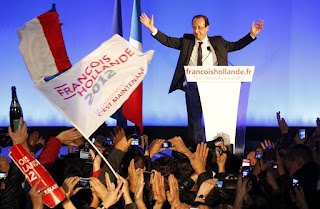 François Hollande, France’s new
President, has promised
to ratify
the European Charter for Regional or Minority Languages, guaranteeing
protection and active support for regional languages in Europe. Hollande’s campaign had vigorous support from
groups advocating for official recognition of regional
languages
(such as Occitan and Breton) due to his expressed
support
for ratifying the Charter during his candidacy.
He did state, however, that the French language should be protected.
François Hollande, France’s new
President, has promised
to ratify
the European Charter for Regional or Minority Languages, guaranteeing
protection and active support for regional languages in Europe. Hollande’s campaign had vigorous support from
groups advocating for official recognition of regional
languages
(such as Occitan and Breton) due to his expressed
support
for ratifying the Charter during his candidacy.
He did state, however, that the French language should be protected.
 The
European Charter for Regional or Minority Languages (click here for full text
in English) is a convention adopted by the Committee of Ministers of the
Council of Europe in 1992. (You can read
the explanation on the Council of Europe’s website here.)
The
European Charter for Regional or Minority Languages (click here for full text
in English) is a convention adopted by the Committee of Ministers of the
Council of Europe in 1992. (You can read
the explanation on the Council of Europe’s website here.)
 The
Conseil Constitutionnel (France’s Supreme Court) decided not to ratify the
Charter because they found it to be unconstitutional. (Click to read
the original decision in French, and an English
translation in PDF form). The main
conflict was between the Charter’s call for official, public use of the
languages in question and the Constitution’s mandate that all official, public
communication be conducted in French.
The
Conseil Constitutionnel (France’s Supreme Court) decided not to ratify the
Charter because they found it to be unconstitutional. (Click to read
the original decision in French, and an English
translation in PDF form). The main
conflict was between the Charter’s call for official, public use of the
languages in question and the Constitution’s mandate that all official, public
communication be conducted in French.
 The
French will need to change the Constitution to allow the Republic to be
“divisible” and to permit other languages in addition to French to be used in
public life. We’ll see what happens.
The
French will need to change the Constitution to allow the Republic to be
“divisible” and to permit other languages in addition to French to be used in
public life. We’ll see what happens.
Jessica Nicholas is a PhD Candidate in the Department of French. Specializing in French Linguistics, she has a particular interest in language ideologies, variation, and education.

What is the European Charter for Regional or Minority Languages, and why has this question become a campaign issue?
 The
European Charter for Regional or Minority Languages (click here for full text
in English) is a convention adopted by the Committee of Ministers of the
Council of Europe in 1992. (You can read
the explanation on the Council of Europe’s website here.)
The
European Charter for Regional or Minority Languages (click here for full text
in English) is a convention adopted by the Committee of Ministers of the
Council of Europe in 1992. (You can read
the explanation on the Council of Europe’s website here.)
The
Council of Europe summarizes it thus:
“The
Charter is a convention designed on the one hand to protect and promote
regional and minority languages as a threatened aspect of Europe’s cultural
heritage and on the other hand to enable speakers of a regional or minority
language to use it in private and public life.”
The regional and minority languages concerned
are those that have a territory within the state in question, have a smaller
population of speakers than the rest of the state, are not official languages
of the state or any dialects thereof, and are not the languages of migrant
groups.
Countries that ratify the Charter
are subject to external oversight to make sure they are adequately meeting the
conditions of the Charter. They have to
prove that they are taking action to promote their regional and minority
languages, provide for the teaching of these languages, and facilitate their
usage in private and public life.
It is precisely with this “public
life” provision where the Charter conflicts with existing French law.
France signed it, but didn’t ratify it. Why not?
In
a divided government under conservative president Jacques Chirac and a leftist
majority Parliament, France signed the Charter in 1999, making a
series of declarations about how the French government would choose to
interpret certain parts of the document.
Most particularly, they took issue with the Charter’s granting of rights
to certain groups within France, which they interpreted to be contrary to the
unity of the French people, and to its requirement that the State facilitate
and encourage the use of the minority languages in the public sphere.
The
conflicting statements in the Constitution (click for full
text in French
and English) are as
follows:
Article 1:
“France shall be an indivisible, secular, democratic and social
Republic. It shall ensure the equality of all citizens before the law, without
distinction of origin, race or religion.”
Therefore,
it would go against the Constitution to recognize separate groups within France
under the law.
Article
2:
“The language of the Republic shall be French.”
Therefore,
no other official status shall be granted to any other language.
Thus,
the Conseil Constitutionnel decided to sign but not ratify the Charter:
“[T]he
specified provisions of the Charter are inconsistent with the
Constitution…Having regard to their nature, none of the other undertakings
entered into by France is contrary to the Constitution, most of them,
incidentally, doing no more than recognize practices that France has already
implemented to promote regional languages.”
In
other words, France signed the Charter because it looked nice but they didn’t
actually have to change anything.
What changes are underway to allow France to ratify the Charter?

Jessica Nicholas is a PhD Candidate in the Department of French. Specializing in French Linguistics, she has a particular interest in language ideologies, variation, and education.
The problem is that recognizing the rights of linguistic minorities is a double-edged sword,because often it's an open door to reverse discrimination. Here in Catalonia,Spain,it's us Spanish speakers who have no linguistic rights.
ReplyDelete